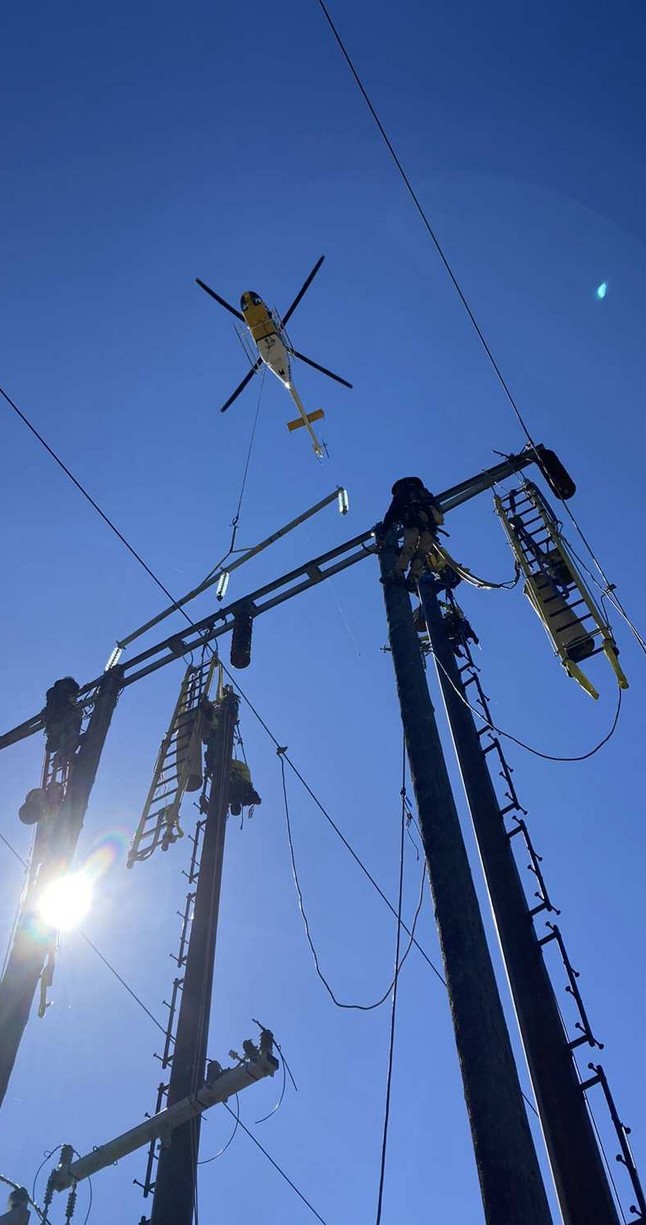
1. Personal Protective Equipment (PPE)
PPE is your last line of defense. It does not eliminate hazards — it protects you when other safeguards fail. Inspect your PPE every day, every shift, before you use it.
No PPE = No Work. Period.
Any worker arriving on site without proper PPE will not begin work until the correct equipment is on. No exceptions. Supervisors are responsible for enforcing this rule on every job site, every day.
1.1 Required PPE — All Field Personnel
- Hard Hat — Class E: Required at all times on site. Class E (Electrical) rated, minimum 20,000 volts. Inspect shell, suspension, and chin strap before every use. Replace after any impact or exposure to chemicals/UV degradation.
- Safety Glasses / Eye Protection: ANSI Z87.1-rated safety glasses or goggles required. Side shields required when working near flying debris, grinding, or overhead work.
- High-Visibility Vest: ANSI Class 2 minimum on all job sites. Class 3 required in all active roadway work zones.
- Leather Work Gloves: Required for all general labor, material handling, and rigging tasks. Gloves must be free of cuts, holes, and chemical contamination.
- Steel-Toed Boots: ASTM F2413-rated safety footwear with puncture-resistant soles. Electrical hazard (EH) rated boots required for all electrical work.
- Arc Flash Rated (FR) Clothing: Flame-resistant clothing is mandatory for all personnel working near energized systems or within approach distances.
1.2 Voltage-Rated Rubber Insulating Equipment
When working within minimum approach distances (MAD) of energized conductors, the following rubber insulating equipment is required in addition to standard PPE:
- Voltage-Rated Rubber Gloves: Must be rated at or above the system voltage being worked. Worn over cotton glove liners. Inspected by air inflation before every use. Replace immediately if any cut, puncture, or deterioration is found.
- Rubber Insulating Sleeves: Worn with rubber gloves to protect forearms from energized contact. Must match glove voltage class.
- Rubber Insulating Blankets & Line Hose: Used to cover adjacent energized conductors and equipment within the work zone.
- All rubber insulating equipment must be tested and certified per ASTM D120 / OSHA 1910.137 requirements. Test dates must be current — check the tag before every use.
1.3 FR (Flame-Resistant) Clothing Requirements
- All clothing worn on energized work sites must be arc-rated FR. Non-FR synthetic fabrics (polyester, nylon, rayon) are strictly prohibited — they melt and cause severe burns in arc flash events.
- FR shirts must be long-sleeved and fully buttoned at the wrist. FR pants must cover the full leg to the boot top.
- Arc flash PPE category (HRC/CAT level) must match the incident energy analysis for the specific task being performed.
- FR garments must be inspected for tears, holes, and contamination. Contaminated FR clothing must be laundered or removed from service — oil or grease contamination negates FR protection.
1.4 PPE Inspection Requirements
- ALL PPE must be visually and physically inspected before each use, at the start of every shift.
- Any PPE showing signs of damage, deterioration, or failure must be immediately removed from service and replaced before work begins.
- Rubber insulating equipment (gloves, sleeves, blankets) requires additional air inflation inspection before each use.
- Hard hats must be replaced after any impact, exposure to harsh chemicals, or at the manufacturer’s recommended replacement interval (typically 5 years from manufacture date).
- Defective PPE must be tagged out and reported to the supervisor — it must never be returned to service without proper repair or replacement by a qualified vendor.
2. Electrical Hazard Awareness
Electricity cannot be seen, smelled, or heard. It can kill in a fraction of a second. Understanding electrical hazards and respecting minimum approach distances is the foundation of electric utility safety.
The Golden Rule: Assume It’s Energized
EVERY conductor, line, and piece of equipment must be treated as energized until it has been: (1) Verified de-energized by testing with an approved meter, (2) Locked out and tagged out by qualified personnel, AND (3) Properly grounded at each work location. If you are not certain — STOP. Verify before you proceed.
2.1 Minimum Approach Distances (MAD)
The following MAD table applies to all qualified electrical workers. Do not enter the restricted or limited approach boundary without proper PPE, rubber insulating equipment, and supervisor authorization.
| System Voltage Range |
Restricted Approach |
Limited Approach |
| Up to 750V | 1 ft 0 in | 2 ft 2 in |
| 751V – 15kV | 2 ft 2 in | 5 ft 3 in |
| 15.1kV – 36kV | 2 ft 7 in | 6 ft 0 in |
| 36.1kV – 46kV | 2 ft 9 in | 6 ft 0 in |
| 46.1kV – 72.5kV | 3 ft 3 in | 6 ft 0 in |
| 72.6kV – 121kV | 3 ft 9 in | 8 ft 0 in |
Source: OSHA 29 CFR 1910.269 / NFPA 70E. MAD values apply to phase-to-ground exposure. Phase-to-phase voltages require additional evaluation.
2.2 Step Potential & Touch Potential Hazards
- Step Potential: When a conductor contacts the ground, electrical current radiates outward through the earth. A worker walking near the fault point completes a circuit through their legs. Do NOT walk or run near a downed line. Shuffle your feet together or hop on both feet to exit the area.
- Touch Potential: A voltage difference between the ground and a grounded object can cause current to flow through a worker touching the object. Do NOT touch poles, guy wires, fences, or equipment near a ground fault without verification.
- The danger zone for step and touch potential extends up to 35 feet from a downed line. Rope off the area and keep bystanders clear.
2.3 Induced Voltage Hazards on De-Energized Lines
- De-energized lines that run parallel to or near energized lines can carry dangerous induced voltages — even with no direct connection to a source.
- Induced voltage can cause severe shock or death. Grounding alone may not eliminate the hazard if ground sets are improperly placed.
- Always test de-energized conductors with a voltage detector before contact, even after LOTO has been applied.
- Ground sets must be placed at each work location — both sides of the work zone — to protect against induced voltage and accidental re-energization simultaneously.
Capacitance Hazard
Long de-energized cable and line sections can store capacitive charge sufficient to cause serious injury. Always discharge and ground before contact. Never assume a long section is safe simply because LOTO has been applied at one end.
3. Lockout / Tagout (LOTO)
LOTO is the single most critical procedural safeguard in powerline work. It ensures that no line or equipment can be accidentally re-energized while workers are in contact with it. There are no shortcuts.
Absolute Rule — No Exceptions
ALL lines and equipment must be de-energized, locked out, tagged out, and grounded before any worker makes contact. This applies to every task — no matter how routine or how short the job seems.
3.1 The Six Steps of LOTO
Follow these six steps in order, every time. Do not skip or combine steps.
| Step | Action | Details |
|---|
| 1 | Notify | Inform all affected personnel, the utility, and your supervisor that de-energization is required. Coordinate switching with the utility’s operating center. |
| 2 | De-Energize | Open the appropriate disconnecting means (switch, breaker, cutout). Confirm with the utility that all sources of energy to the line are open. |
| 3 | Isolate | Visually verify that all isolation points are open and that no alternate feed paths remain. Identify all possible back-feed sources. |
| 4 | Lock / Tag | Apply a personal lock AND a danger tag at every isolation point. Each worker applies their own individual lock. Tags alone are never sufficient. |
| 5 | Release Stored Energy | Apply grounds at each work location to drain induced and capacitive voltage. Use rubber-gloved technique to apply ground sets — treat as energized until grounded. |
| 6 | Verify | Test the conductor with an approved voltage tester before any contact. Confirm voltage is absent. If voltage is present — STOP and notify your supervisor. |
3.2 Personal Locks — Individual Responsibility
- Every worker in the work zone must apply their own personal lock at every isolation point. A crew lock or foreman’s lock does not protect individual workers.
- Each worker is responsible for their own lock — carry it, apply it, and remove it yourself.
- Personal locks must be keyed individually — no two workers’ locks should share a key.
- NEVER remove another worker’s personal lock under any circumstances. If a lock cannot be removed in a normal manner, notify the supervisor and follow the company’s abandoned lock removal procedure.
3.3 Grounding Requirements
- Ground sets must be applied at each work location — on both sides of the work zone — to protect against induced voltage and any accidental re-energization from either direction.
- Ground sets must be rated for the fault current of the system being worked. Using an under-rated ground set is as dangerous as using no ground at all.
- Apply grounds using rubber gloves and hot-line tools — treat the line as energized during ground application.
- Grounds must remain in place until ALL workers have cleared the work zone and all tools and equipment have been removed.
3.4 LOTO Removal — Restoration of Energy
- LOTO must not be removed until every worker has removed their personal lock and confirmed they are clear of the work zone.
- Remove ground sets before closing isolation points — grounds must come off last during de-energization and go on first during restoration.
- Notify the utility operating center that work is complete and the line is clear before requesting re-energization.
- A final walk of the work zone must be completed before re-energization is authorized.
Never Remove Another Worker’s Lock
Removing another person’s lock — for any reason, including shift change, emergency, or impatience — is a serious safety violation. Only the person who applied the lock may remove it.
4. Climbing & Aerial Work Safety
Falls are one of the leading causes of fatalities in utility construction. 100% tie-off and proper pole inspection before every climb are not suggestions — they are requirements.
100% Tie-Off Rule — No Exceptions Above 4 Feet
Fall protection is required at all heights greater than 4 feet on any structure. You must be tied off at ALL times when climbing or working aloft — no free-climbing between positions without maintaining continuous fall protection.
4.1 Fall Protection Requirements
- A full-body harness rated for fall arrest is required for all work aloft. Body belts are approved for positioning only — they are not fall arrest devices.
- 100% tie-off requires that you maintain a continuous connection to an approved anchor point at all times. Use a dual-leg lanyard or positioning lanyard to move between positions without disconnecting.
- Inspect all fall protection equipment (harness, lanyards, hooks, D-rings, stitching) before every use. Remove any equipment with cuts, worn stitching, deformed hooks, or corrosion from service immediately.
- Fall protection equipment that has caught a fall must be immediately removed from service and destroyed — it cannot be re-used.
4.2 Pole Inspection Before Climbing
Never climb a pole without first inspecting its condition from the ground. Check for:
- Rot & Decay: Sound the pole with a hammer at the ground line. A hollow sound indicates internal decay. Do not climb a rotten pole.
- Cracks & Splits: Longitudinal cracks that are deep or encircle the pole may indicate structural failure risk.
- Woodpecker Holes: Multiple or deep woodpecker holes can significantly weaken a pole.
- Pole Lean: Excessive lean may indicate a compromised base or root. Evaluate before climbing.
- When in doubt — do not climb. Notify your supervisor and have the pole evaluated by a competent person.
4.3 Climbing Equipment Inspection
- Inspect hooks (gaffs), straps, pads, and buckles before every climb. Check for bent, broken, or dull gaffs — dull gaffs cause slipping.
- Gaff guards must be worn whenever not actively climbing to prevent injury.
- Climber straps must show no cracks, cuts, or excessive wear at stress points. Replace if any damage is found.
- Do not wear climbers with damaged buckles or fasteners — verify positive engagement before ascending.
4.4 Aerial Lifts & Bucket Trucks
- Aerial devices must be inspected daily per the manufacturer’s inspection requirements and applicable ANSI/SAIA A92 standards before each use.
- No side loading of aerial devices. Operate only within the rated capacity and working envelope of the unit.
- Outriggers must be fully deployed and stabilized on solid ground before any personnel enter the bucket.
- Personnel must wear a full-body harness and be attached to the boom anchorage point while in the bucket.
- No personnel on or in equipment during travel — all workers must be clear of the equipment and its path before moving.
- Metal booms operating near energized lines must be grounded per utility requirements.
Never Work Aloft Alone
A ground person must maintain visual contact with any worker aloft at all times. The ground person’s primary responsibility is observation and emergency response — they must not be distracted by other tasks.
5. Work Zone & Traffic Control
Being struck by a vehicle is a leading cause of work-related fatalities in road construction and utility work. Proper traffic control setup is a life-safety requirement — not a formality.
Set Up Traffic Control First — Before Any Work Begins
Traffic control must be fully in place BEFORE any worker, vehicle, or equipment enters the work zone near a roadway.
5.1 Traffic Control Standards
- All work zone traffic control must comply with the Manual on Uniform Traffic Control Devices (MUTCD), current edition, and all applicable state DOT requirements.
- Advance warning signs, tapers, and buffer zones must meet minimum spacing requirements for posted speed limits.
- Channelizing devices (cones, drums, barriers) must be visible, upright, and properly weighted. Replace any knocked-down devices immediately.
- Arrow boards or flashing warning lights are required when lane closures are in effect.
- A written traffic control plan must be available on site for any work in or adjacent to a roadway.
5.2 High-Visibility Requirements in Traffic Zones
- ANSI/ISEA 107 Class 3 high-visibility vests or garments are required for all personnel working in any active roadway work zone.
- All supervisors and flaggers must wear Class 3 gear at all times.
- Class 2 vests are acceptable only in off-road work zones away from active traffic.
5.3 Flagging & Spotter Requirements
- A trained flagger is required whenever workers or equipment are operating adjacent to or within moving traffic lanes.
- A dedicated spotter is required anytime equipment is operating near active traffic. The spotter’s sole job is watching for traffic.
- Flaggers must be trained and certified per MUTCD requirements. They must carry a Stop/Slow paddle and use MUTCD-approved hand signals.
5.4 Worker Awareness in Traffic Zones
- Never turn your back to oncoming traffic. Position yourself so you can see approaching vehicles at all times.
- Be aware of distracted and impaired drivers — assume vehicles may drift into the work zone.
- Keep an escape route planned at all times.
- Maintain situational awareness: do not use personal cell phones or listen to music in a work zone.
5.5 Emergency Vehicle Access
- Emergency vehicle access must be maintained at all times throughout the work zone.
- All crew members must know the job site address before work begins.
- If an emergency vehicle needs to pass through the work zone, flaggers must stop all work traffic and create a clear path immediately.
6. Equipment & Tool Safety
Defective tools and improperly used equipment cause serious injuries and fatalities. Inspect every tool every shift. If it’s damaged — tag it out and remove it from service.
6.1 Hand Tools & Power Tools
- Inspect all hand tools and power tools before every use. Look for cracked handles, damaged insulation, bent shanks, loose heads, and missing guards.
- Remove any defective tool from service immediately. Tag it “DO NOT USE” and report it to the supervisor.
- Use the right tool for the job. Never use a tool for a purpose other than its intended use.
- Keep cutting tools sharp. Dull tools require more force, leading to slipping and loss of control.
- Store tools properly — capped, sheathed, or bagged — when not in use.
6.2 Voltage-Rated Tools for Energized Work
- All tools used on or near energized conductors and equipment must be properly voltage-rated. Minimum 1,000V rating required for all energized work tools.
- Never use a tool rated below the voltage of the system being worked on. Verify the voltage rating marked on the tool before every use.
- Inspect the insulation on voltage-rated tools before each use. Any cut, crack, pinhole, or deteriorated insulation removes the tool from service immediately.
- Voltage-rated tools must be tested per IEC 60900 / ASTM F1505 requirements. Check test date stickers — never use a tool with an expired test date.
- Hot-line tools (hot sticks, live-line tools) must be clean, dry, and inspected for damage before each use.
6.3 Aerial Devices — Daily Inspection
- Aerial devices (bucket trucks, digger derricks, crane trucks) must be inspected at the start of every shift per the manufacturer’s inspection checklist.
- Check: hydraulic fluid levels, leaks, outrigger function, boom operation, bucket integrity, safety devices (interlocks, emergency lowering system), and all warning labels.
- Any aerial device that fails inspection or develops a defect during use must be taken out of service immediately.
6.4 Equipment Near Energized Lines — Grounding
- All equipment with metal booms, masts, or arms operating near energized overhead lines must maintain required minimum approach distances.
- When working within approach distances is required, the equipment must be bonded and grounded per utility specifications by a qualified person using rubber-gloved technique.
- No personnel on equipment during travel — all workers must be clear before any piece of equipment is moved.
- A spotter must guide equipment movement when overhead energized lines are present.
Equipment Clearances Are Not Optional
Crane and boom contact with overhead powerlines is one of the most common causes of electrical fatalities in construction. NEVER assume a line is de-energized based on appearance. Maintain MAD at all times.
7. Digging & Excavation Safety
Striking a buried utility line or entering an unprotected trench are potentially fatal events. Follow all dig safe procedures every time — there are no shortcuts in underground work.
Call 811 Before Any Dig — No Exceptions
State law requires contacting 811 before any excavation. Failure to call 811 before digging is a violation of state law and J&J Line Services policy. No exceptions — no matter how small or shallow the dig.
7.1 Dig Safe — Call 811
- Call 811 a minimum of 3 full business days before any excavation begins. Allow adequate time for all utilities to respond and mark their lines.
- Verify that ALL locates have been received (cable, gas, electric, fiber, water, sewer) before digging begins.
- Locate marks are valid for a specific ticket window — do not use expired locate tickets.
7.2 Verify Locates On-Site Before Digging
- Walk the locate marks on-site before breaking ground. Verify that marks align with expected utility routing.
- Never assume locates are perfectly accurate. Locates are approximate — utility lines can shift, settle, or be installed outside of standard depths.
- Hand dig (pothole or hydrovac) within 18 inches of any marked utility to expose and verify its exact location before mechanized digging.
- Document the verified utility location with photos and notes before backfilling the pothole.
7.3 Trench & Excavation Safety
- All trenches and excavations 5 feet deep or greater require a protective system: sloping, shoring, or shielding (trench box) per OSHA 1926 Subpart P.
- A competent person (as defined by OSHA) must be on-site for all excavation work and must inspect the excavation daily and after any condition change.
- Spoil piles must be placed a minimum of 2 feet from the edge of the excavation.
- Ladders must be available in all trenches deeper than 4 feet — no worker should be more than 25 feet of lateral travel from an exit point.
7.4 Confined Space Entry
- Manholes, vaults, and enclosed excavations may be permit-required confined spaces. Evaluate every below-grade entry point before entry.
- Test the atmosphere with a calibrated multi-gas meter before any worker enters: oxygen (19.5%–23.5%), flammable gases (below 10% LEL), toxic gases (below PELs).
- Continuous atmospheric monitoring is required during confined space occupancy.
- A trained attendant must remain outside the confined space while any worker is inside.
- Rescue equipment (tripod, retrieval harness, communications) must be on-site before entry begins.
Struck-By & Cave-In Are Fatal Hazards
Trench collapses can occur without warning. A cubic yard of soil weighs approximately 2,700 lbs — a collapsed trench wall can kill instantly. Never enter an unprotected trench.
8. Incident & Near-Miss Reporting
Near-misses are warnings. Incidents are tragedies. Reporting both — immediately and honestly — is how we prevent the next one. J&J Line Services operates a no-fault reporting culture. Every report is a gift to the next crew.
Report Immediately — Every Time
ALL incidents, injuries, near-misses, and property damage — no matter how minor they appear — must be reported immediately to the supervisor on site. Do not wait. Do not minimize. Report it now.
8.1 What Must Be Reported
- Any work-related injury, illness, or physical complaint — including minor cuts, strains, and headaches that occur during work
- Any near-miss event: a situation in which an injury or property damage nearly occurred but did not
- Any property damage — to equipment, vehicles, tools, third-party property, or utility infrastructure
- Any safety rule violation observed — your own or another crew member’s
- Any unsafe condition discovered on the job site
8.2 No-Fault Reporting Policy
- J&J Line Services maintains a no-fault, no-retaliation reporting policy. Workers who report incidents, near-misses, or unsafe conditions in good faith will not face discipline for the act of reporting.
- The goal of incident reporting is to investigate, learn, and prevent — not to assign blame.
- Workers who withhold incident reports or discourage others from reporting will face disciplinary action.
8.3 Supervisor Responsibilities After an Incident
- Ensure the injured worker receives first aid or emergency medical care immediately.
- Preserve the incident scene — do not move equipment, tools, or materials until the investigation is complete.
- Secure the area and control access to the incident scene.
- Notify J&J Line Services management immediately.
- Complete the required incident report forms within 24 hours of the event.
8.4 First Aid & Emergency Contacts
- A fully stocked first aid kit must be present in every J&J Line Services company vehicle at all times.
- Emergency contact numbers must be posted in every vehicle and available on every job site.
- At least one crew member per job site must hold a current CPR/First Aid certification.
9. Emergency Procedures
Knowing what to do in the first 60 seconds of an emergency can save a life. Review these procedures at every pre-job briefing. Every crew member must know the plan before work starts.
Electrical Contact — Do NOT Touch the Victim
If a worker is in contact with an energized line or piece of equipment: DO NOT TOUCH THEM. You will also become a victim. Call 911 immediately. Do not attempt victim contact until the source of electricity is confirmed de-energized by the utility.
9.1 Electrical Contact / Electrocution Response
- Call 911 immediately. State the nature of emergency, the job site address, and the number of persons affected.
- Do NOT touch the victim if they are still in contact with an energized source.
- Shut off power at the nearest safe isolation point if it can be done quickly and without risk.
- Keep bystanders away from the victim and the work zone. Enforce the step and touch potential hazard zone (35-foot minimum).
- Once the scene is confirmed safe, trained CPR/AED responders should begin assessment and treatment.
- Preserve the incident scene for investigation.
9.2 Downed Power Line Response
- Call 911 and call the utility’s emergency operations center immediately.
- Establish a perimeter of at least 35 feet in all directions from the downed line.
- Assume the line is energized. Do not approach or attempt to move the line.
- If a vehicle has contact with a downed line — the occupants must stay inside the vehicle unless fire forces evacuation, in which case they must jump clear without touching the vehicle and ground simultaneously.
9.3 Fire Response
- Alert all crew members and evacuate the area.
- Call 911 immediately.
- Use a fire extinguisher only for small, contained fires if you have been trained.
- Account for all crew members at the designated muster point.
- Notify utility emergency operations if fire threatens any energized infrastructure.
9.4 Medical Emergency Response
- Call 911 immediately for any serious injury, loss of consciousness, chest pain, or difficulty breathing.
- Trained crew members should begin CPR/AED if the worker is unresponsive and not breathing.
- Send a crew member to the site entrance to guide emergency vehicles in.
- Do not move an injured worker with potential spine injuries unless they are in immediate life-threatening danger.
9.5 Emergency Contact Reference
| Emergency Type | Contact | Number |
|---|
| Medical / Fire / Police | 911 | 9-1-1 |
| Dig Safe / Underground Utility Locate | 811 | 8-1-1 |
| Utility Emergency Operations Center | Posted in vehicle / pre-job briefing | Per job site utility |
| J&J Line Services Management | Posted in vehicle | Per company directory |
9.6 Muster Point
- A muster point must be designated at every job site during the pre-job briefing each morning.
- All crew members must know the muster point location before work begins.
- In any emergency requiring evacuation, all personnel report to the muster point and remain there until a supervisor accounts for the entire crew.
- All crew members must know the complete job site address before work begins each day.
10. Daily Job Site Briefing (Tailgate Safety)
The tailgate safety briefing is the most important five minutes of the workday. It is where hazards are identified, roles are assigned, and the emergency plan is confirmed. It is not optional — it is the standard.
Required Every Day — Before Any Work Begins
A tailgate safety briefing is required every single workday before any task begins. It does not matter if it is the same job site, the same crew, or the same task as the day before. Every day is a new briefing.
10.1 Required Topics — Every Briefing
- Hazards of the Day’s Work: Identify specific hazards for today’s planned tasks — electrical, fall, excavation, traffic, equipment, weather, and any site-specific conditions.
- PPE Requirements: Confirm all required PPE for the day’s scope of work is on-site, inspected, and properly fitted.
- Emergency Plan: State the job site address, designated muster point, location of the first aid kit, and emergency contacts for the day.
- LOTO Plan: Confirm LOTO requirements for any energized work planned during the shift.
- Roles & Responsibilities: Confirm who is the lead, who is the flagger, who is the ground person for aerial work, and any other designated roles for the day.
- Equipment Status: Confirm aerial devices and vehicles have been inspected and are in safe working condition.
10.2 Crew Participation & Documentation
- All crew members must actively participate in the tailgate briefing — attendance is mandatory.
- Every crew member present must sign the Daily Tailgate Safety Sheet at the completion of the briefing.
- Completed tailgate sheets must be retained per company recordkeeping policy.
10.3 Visitors & Unauthorized Personnel
- All visitors entering the work zone must receive a safety orientation before entering.
- Unauthorized persons must be kept out of the work zone at all times.
10.4 Stop Work Authority — Every Crew Member
Stop Work Authority — Every Worker, Every Time
Any J&J Line Services crew member has the right and the responsibility to STOP WORK immediately if they observe or identify an unsafe condition, an uncorrected hazard, or any situation that feels wrong. Stop work. Notify the supervisor. Do not resume until the hazard is resolved.
There will be no retaliation — ever — against any worker who exercises stop work authority in good faith. The job can always be done tomorrow. The crew cannot be replaced.