1. General Safety Policy
J&J Line Services is committed to providing a safe working environment for all employees, subcontractors, and the public. Safety is not a priority that shifts — it is a core value embedded in every operation we perform. Every crew member has the authority and the obligation to stop work when conditions are unsafe.
- All work shall comply with OSHA 29 CFR 1926 (Construction) and 1910 (General Industry) standards
- A tailboard job briefing shall be conducted before every task, every day, without exception
- All incidents, near-misses, and unsafe conditions shall be reported immediately to the foreman and Director of Telecommunications
- No employee shall be required or permitted to work in conditions that pose an imminent danger to life or health
- Substance abuse is strictly prohibited — all employees are subject to pre-employment and random drug testing
- Horseplay, shortcuts, and deviation from established procedures are not tolerated
- All crew members have unconditional Stop Work Authority — no retaliation for exercising it
2. Personal Protective Equipment (PPE)
PPE is the last line of defense against workplace hazards. All crew members are required to wear the appropriate PPE for the task being performed. PPE must be inspected before each use and replaced immediately if damaged or defective.
Minimum PPE for all telecom jobsites:
- ANSI Z89.1 hard hat (Class E when near power lines)
- ANSI Z87.1 safety glasses with side shields
- ANSI/ISEA 107 high-visibility vest or shirt
- ASTM F2413 steel-toe or composite-toe work boots
- Leather or mechanics work gloves appropriate for the task
Task-specific PPE:
- Heights / climbing: ANSI Z359.11 full-body harness, shock-absorbing lanyard, positioning belt
- Fiber optic splicing: Fiber-safe safety glasses, disposal container for fiber scraps
- Directional bore / excavation: Hearing protection, face shield if using pneumatic tools
- Manhole / vault entry: Confined space entry kit, atmospheric monitor, retrieval system
- Near energized conductors: FR clothing, Class E hard hat, rubber insulating gloves (if required by utility)
3. Aerial Cable & Strand Safety
Aerial telecommunications work involves placing, lashing, and maintaining cables on utility poles. These operations carry risks from heights, traffic, weather, and proximity to energized power conductors.
- Always identify and maintain safe clearances from power lines before starting aerial work
- Strand and cable shall not be placed or tensioned during lightning, high winds (>35 mph sustained), or ice storms
- Use proper rigging, cable blocks, and pulling equipment rated for the load
- Guard ropes and pull lines shall be controlled at all times to prevent contact with power lines
- Bucket trucks and aerial lifts shall be operated only by trained and authorized personnel
- Outriggers must be fully deployed and on solid ground before raising the boom
- Traffic control (signs, cones, flaggers) must be in place when working along or over roadways
- Never stand under a suspended load or in the fall zone of cable being tensioned
- All lashing wire ends shall be properly secured and covered to prevent injury
4. Underground & Directional Bore Safety
Underground cable placement involves trenching, plowing, and directional boring — all of which carry risk of striking buried utilities, cave-ins, and heavy equipment hazards.
- 811 / utility locates must be called and confirmed before any excavation begins — no exceptions
- Hand-dig (pothole) within 18 inches of all marked utilities before using mechanical equipment
- Maintain a spotter when operating directional bore machines, trenchers, or cable plows near utilities
- Monitor bore head location continuously using a locating device — never assume a straight path
- Trenches deeper than 5 feet require shoring, sloping, or a trench box per OSHA requirements
- Keep all personnel clear of the bore path and pull-back zone during active operations
- Inspect drilling fluid (mud) returns regularly — loss of returns may indicate a bore path deviation
- All open trenches must be barricaded, plated, or backfilled before leaving the jobsite
- Restore all surfaces (pavement, sidewalks, landscaping) to pre-construction condition
5. Fiber Optic Safety
Fiber optic cable transmits data using laser light. Bare fiber strands are extremely sharp and nearly invisible. Improper handling can cause eye injury and embedded glass fragments in skin.
- Never look into the end of a fiber cable or connector — invisible infrared laser light can cause permanent retinal damage
- Always use an optical power meter to verify fiber status before handling — assume all fibers are active (lit) until confirmed otherwise
- Wear fiber-safe safety glasses when stripping, cleaving, or splicing fiber
- Collect all fiber scraps and place them in a designated sharps container — never leave scraps on floors, tables, or clothing
- Use a fiber scrap disposal mat (dark-colored adhesive pad) during splicing operations
- Wash hands thoroughly after handling bare fiber — do not rub eyes or touch face
- Work in a clean, well-lit, and ventilated area when using splice enclosure sealants or adhesives
- Visual fault locators (VFL) emit visible red laser light — never point at eyes or reflective surfaces
- Keep fusion splicer electrodes maintained per manufacturer specifications
6. Pole & Tower Climbing Safety
Climbing utility poles and telecommunications towers is among the highest-risk activities in the industry. Fall protection, proper training, and strict adherence to procedures are mandatory.
- Only trained, authorized, and medically qualified personnel shall climb poles or towers
- 100% fall protection (tie-off) is required at all times once feet leave the ground
- Inspect all climbing equipment (harness, lanyards, gaffs, climbers, positioning straps) before each use
- Do not climb in lightning, high winds, ice, or other adverse weather conditions
- Establish a fall rescue plan before any climbing operation — rescue equipment must be on-site
- Maintain three points of contact when ascending or descending
- Inspect wood poles for rot, damage, insect infestation, and hardware integrity before climbing
- When climbing joint-use poles, identify all energized conductors and maintain required clearances
- Tools and materials shall be hoisted using a hand line — never carried while climbing
- Tag out and remove from service any defective climbing equipment immediately
7. RF Exposure Safety
Telecommunications towers and rooftop sites may have active radio frequency (RF) transmitters. Overexposure to RF energy can cause tissue heating and other health effects.
- All personnel working on or near active antenna sites must have RF awareness training
- Review the site RF safety plan and posted signage before beginning work
- Use an RF personal monitor when working within controlled or restricted areas
- Request reduced power or lockout of antennas before working within the controlled area boundary
- Never position yourself directly in front of an active antenna — stay below or behind
- Comply with FCC OET Bulletin 65 maximum permissible exposure (MPE) limits at all times
- If an RF monitor alarms, immediately move away from the source and notify the foreman
- Report any symptoms of RF overexposure (skin warming, headache, dizziness) immediately
8. Working Near Power Lines
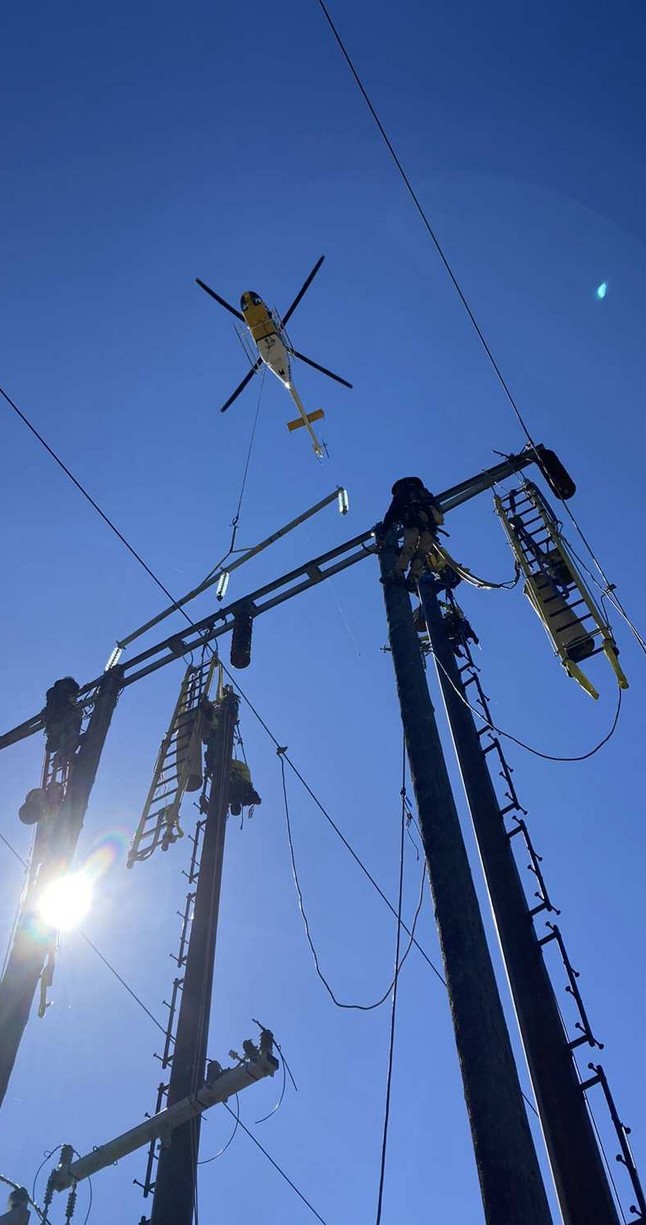
Telecommunications infrastructure frequently shares utility poles and rights-of-way with energized power lines. Contact with or arcing from power conductors is immediately life-threatening.
- Identify all energized conductors and their voltage before starting any work on joint-use structures
- Maintain OSHA-required minimum approach distances at all times (10 feet for systems up to 50kV)
- Never assume a line is de-energized — treat all conductors as energized until confirmed and grounded
- Coordinate with the power utility when work requires reduced clearances or outages
- Cable and strand shall not be placed, moved, or tensioned in a manner that could contact or sag into power lines
- Ground all metallic cable sheaths and strand to the pole ground per utility and NEC requirements
- Aerial lift trucks must maintain required clearances — use a spotter when operating near energized lines
- In the event of accidental power line contact, stay in the vehicle and call 911 — hop clear only if the vehicle is on fire
9. Confined Space Entry (Manholes & Vaults)
Telecommunications manholes, handholes, and underground vaults are confined spaces that may contain hazardous atmospheres, standing water, or vermin. Entry requires specific training and procedures.
- All confined space entries must comply with OSHA 29 CFR 1910.146
- Test the atmosphere with a calibrated 4-gas monitor (O2, LEL, CO, H2S) before entry and continuously during occupancy
- Ventilate the space with a mechanical blower for a minimum of 15 minutes before entry
- A trained attendant must remain at the entry point at all times during occupancy
- A retrieval system (tripod and winch or equivalent) must be set up before entry
- Never enter a confined space to rescue a downed worker — call 911 and use the retrieval system
- Pump out standing water before entry when possible — use GFCI-protected pumps
- Place traffic control and manhole guards around open manholes on roadways or sidewalks
- Complete and post a confined space entry permit for each entry event
10. Driving & Vehicle Safety
Motor vehicle incidents are a leading cause of workplace fatalities in the utility construction industry. Safe driving is a non-negotiable standard at J&J Line Services.
- All drivers must possess a valid driver's license appropriate for the vehicle being operated (CDL if required)
- Seatbelts are mandatory for all occupants at all times — no exceptions
- Cell phone use while driving is prohibited — pull over to make or take calls
- Perform a pre-trip inspection (lights, brakes, tires, fluids, mirrors, load securement) before departing
- Obey all posted speed limits and adjust speed for conditions (rain, fog, construction zones)
- Use a spotter when backing any vehicle or equipment — if no spotter is available, walk around the vehicle first
- Secure all tools, materials, and equipment before transport — unsecured loads are a hazard to other motorists
- Report all accidents, damage, and moving violations to the foreman immediately
11. Emergency Procedures
Every crew must have an emergency action plan established during the daily tailboard briefing. All crew members must know the location of the nearest hospital, the 911 dispatch address, and the muster point.
- Electrical contact: Do not touch the victim. De-energize the circuit if possible. Call 911. Begin CPR if the victim is unresponsive and not breathing.
- Fall from height: Do not move the victim unless in immediate danger. Call 911. Stabilize the head and neck. Treat for shock.
- Struck-by / caught-between: Secure the scene to prevent further injury. Call 911. Control bleeding and treat for shock.
- Confined space emergency: Do not enter the space. Activate the retrieval system. Call 911. Begin ventilation if safe to do so.
- Vehicle accident: Check for injuries. Move to a safe location if possible. Call 911 and the company foreman. Exchange information and document the scene.
- Fire: Evacuate to the muster point. Call 911. Use a fire extinguisher only if the fire is small and you are trained. Account for all personnel.
- First aid kits, fire extinguishers, and AEDs (where provided) must be accessible on every jobsite
- All incidents — including near-misses — must be documented and reported within 24 hours
12. Training & Compliance
All J&J Line Services telecom personnel are required to complete the following training and maintain current certifications as applicable to their role:
- New hire safety orientation (before first day on a jobsite)
- OSHA 10-Hour Construction Safety (minimum)
- Fall protection and rescue training (annual refresher)
- Confined space entry and rescue awareness
- First aid / CPR / AED certification (current)
- RF awareness training (for tower and rooftop work)
- Fiber optic safety and handling procedures
- Flagging and traffic control (as required by jurisdiction)
- Aerial lift and bucket truck operator certification
- Directional bore operator training (equipment-specific)
- Hazard communication (GHS / SDS awareness)
- Company-specific safety manual review (annual acknowledgment)
Training records are maintained by the Director of Telecommunications. Any crew member whose certifications have lapsed shall not perform the associated task until recertification is complete.